Weaving living moss into a garment — to move the relationship between human and moss from looking to interfering.
I turned a dead metaphor from 13th-century Japanese poetry — koke no koromo, “the robe of moss” — into a living garment: a wearable that breathes, cools, resists, and dies, forcing co-existence to be negotiated on the skin rather than admired from a distance.
For over a thousand years, the relationship between people and moss in Japan stayed inside a single, unbroken frame: the viewer and the viewed.
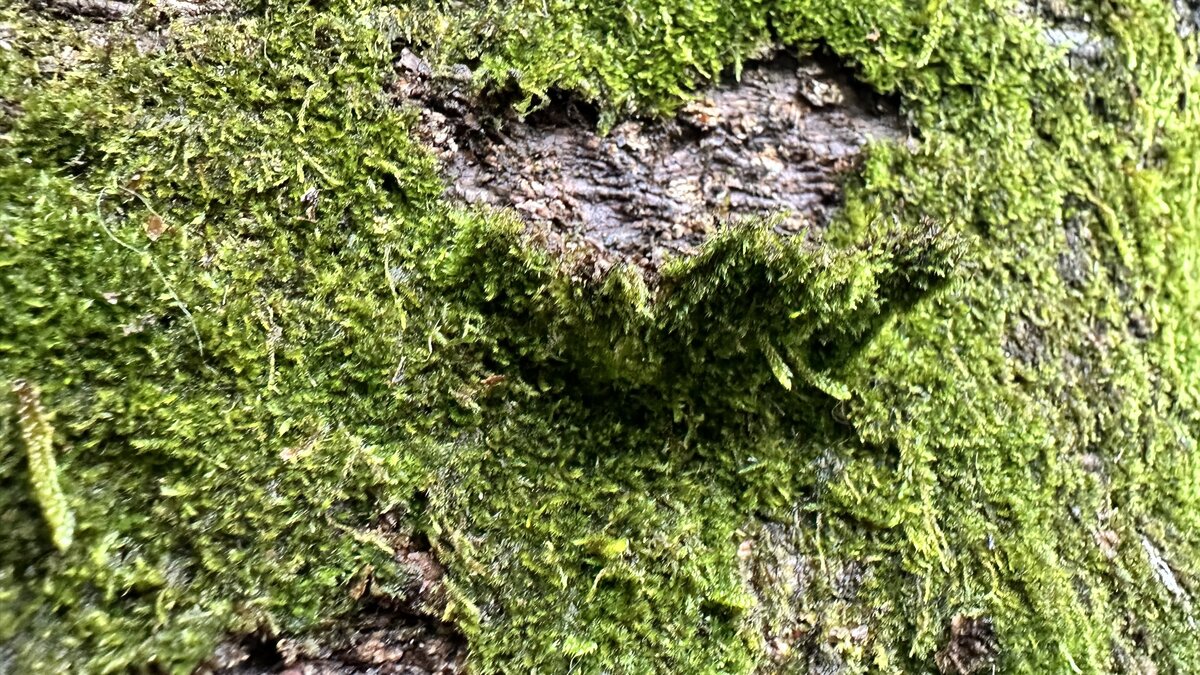
Moss appears in waka poetry, temple gardens, bonsai, glass terrariums — and across all of them the human holds the power to assign meaning while the moss is arranged to be looked at. The physical distance narrowed over the centuries, from distant gardens to a terrarium on a desk, but the form of the relationship never changed. Moss remained an object of contemplation, never a participant.
I wanted to test whether that frame could be broken — not argued against in theory, but broken in matter, on a body, with a living organism that could refuse.
The project began as cross-disciplinary artistic research, deliberately holding together three fields usually kept apart — and the insight that organised everything came from their intersection.
A metaphor whose meaning has drained away is not a dead end. It is an opening. If the old koke no koromo stood for spiritual separation from the world, a new one could be built to mean physical connection to it.
The medieval poets never wore moss. They wore the idea of moss. My proposition was to collapse that distance to zero — and see what relationship emerges when a human and a living organism share the same few millimetres of space.The concept · 03
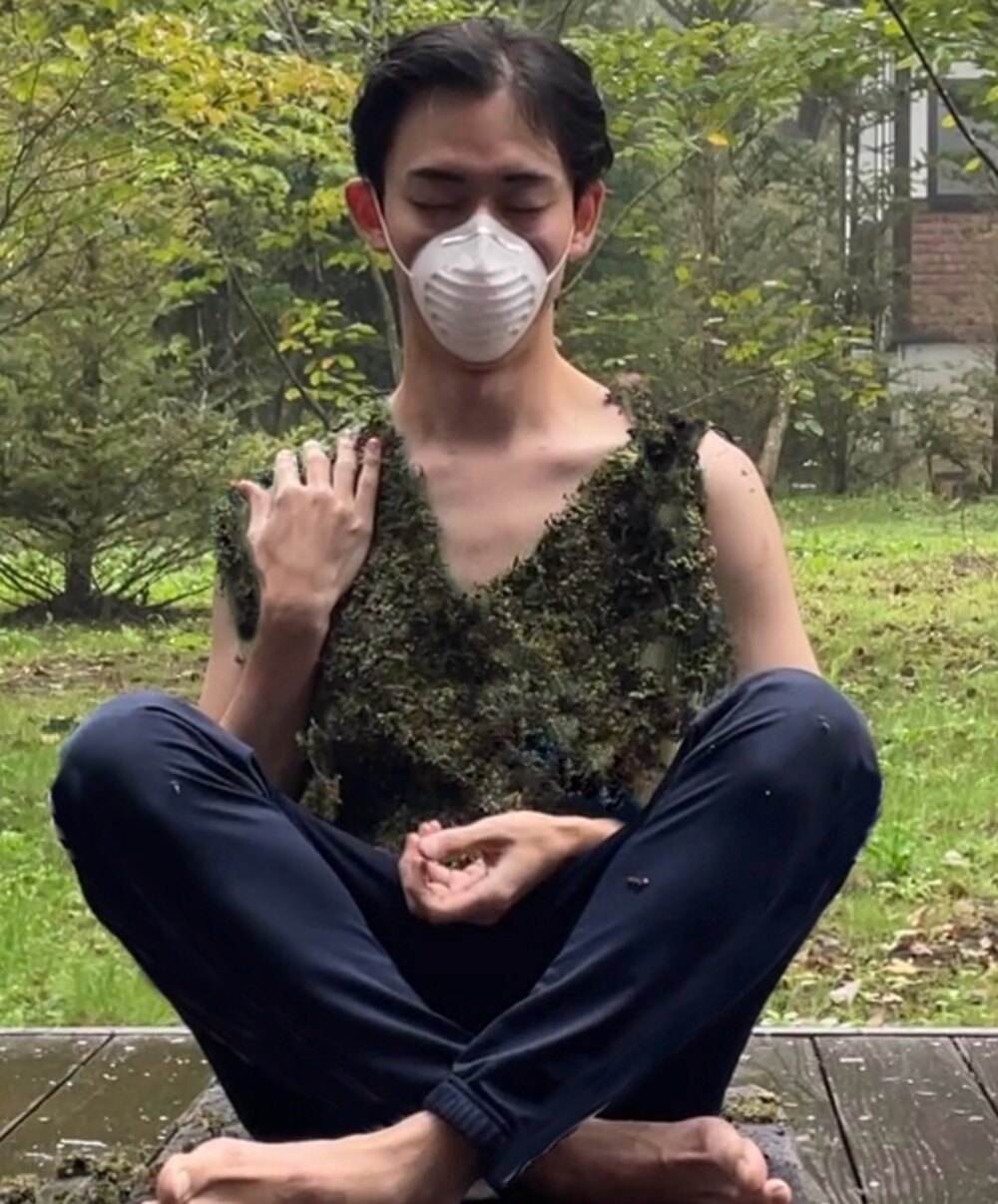
The first attempt — a “moss vest” bound by the plant's own rhizoids — held for about fifteen minutes, then collapsed the moment I shifted posture.
Worse, the spore-bearing moss, worn close to the face, caused respiratory irritation severe enough that I wore a dust mask thereafter. A double failure — structural and physiological.
It became the most important result of the early phase: it proved that wearing a living thing is not a strength problem but a relationship problem — one that includes the body's own defensive rejection.
So I redesigned around the moss's own biology.
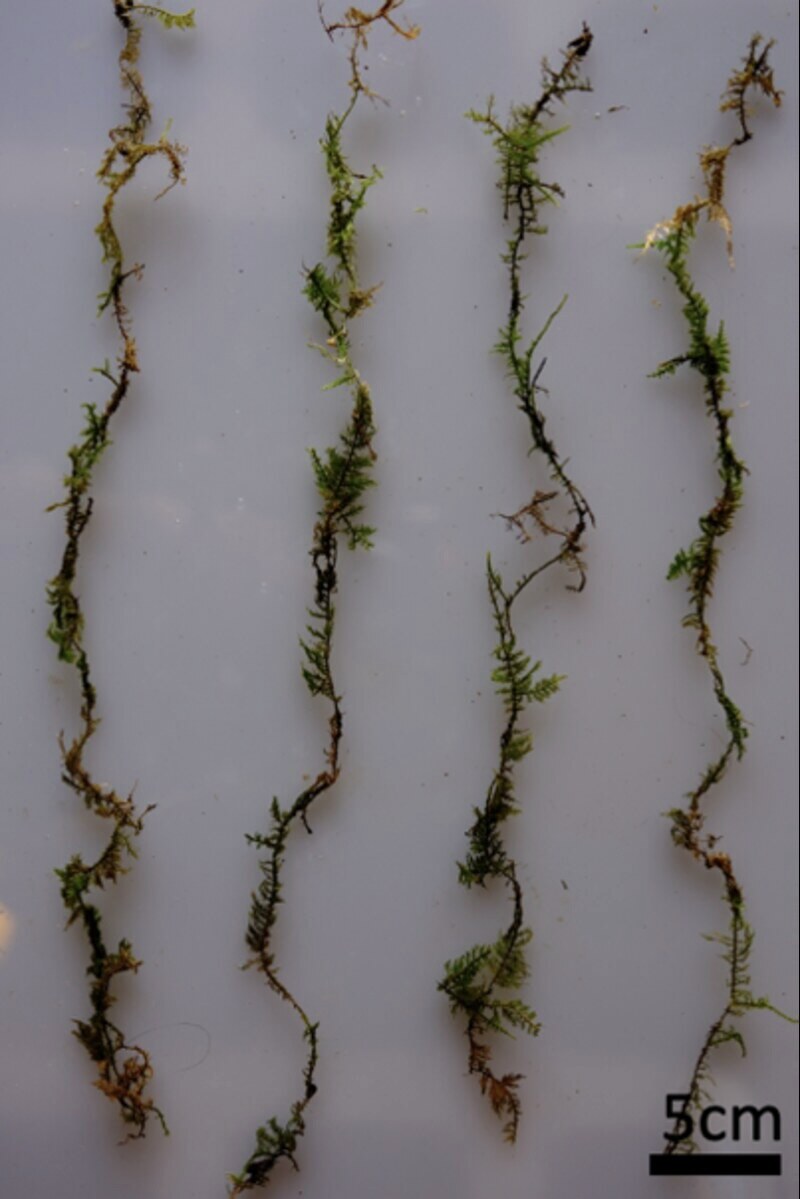
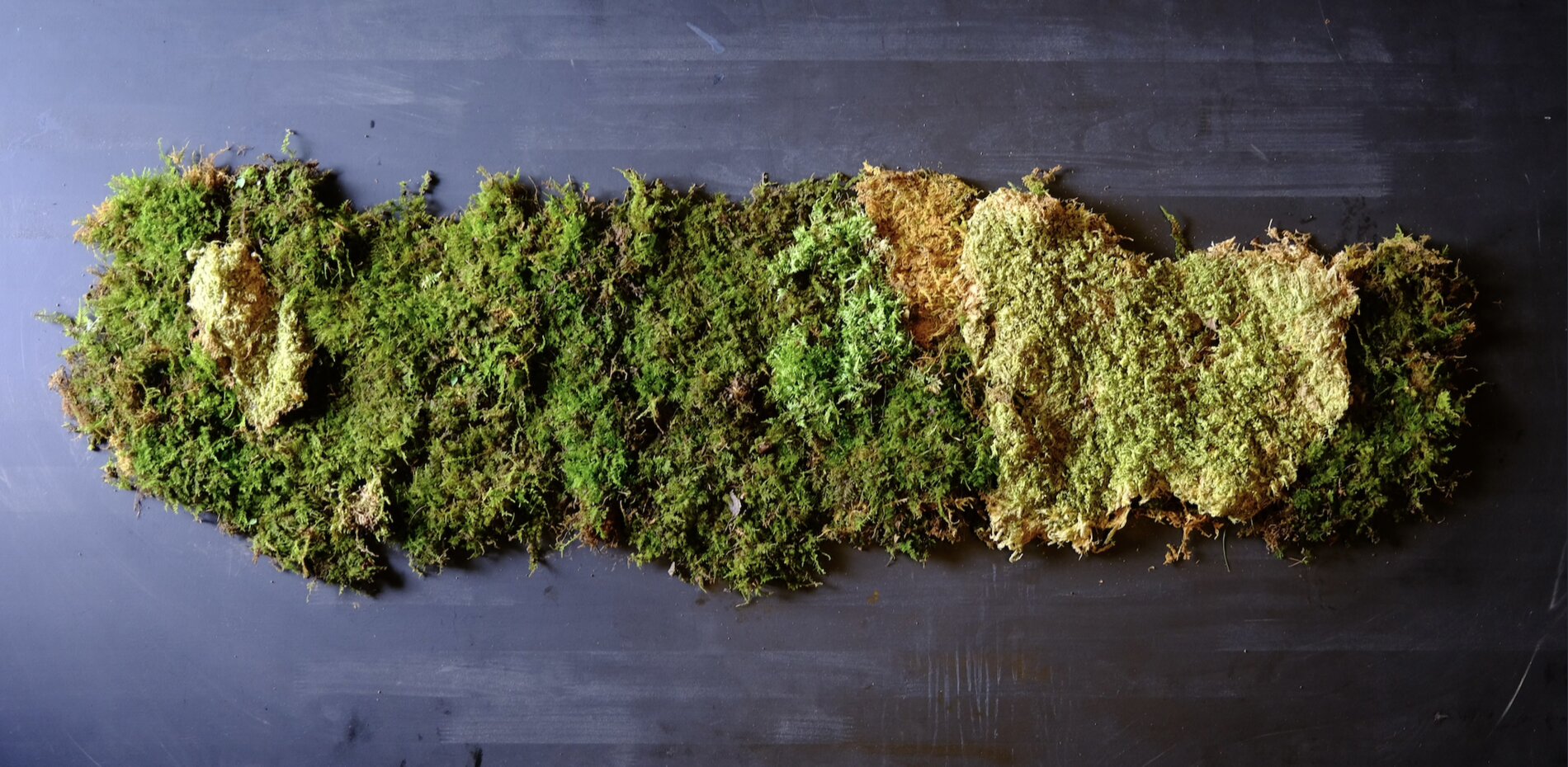
Working the stems by hand, I found a directional rule: twisted crosswise they will not join, but twisted along the growth axis they interlock. Exploiting wet/dry cycling to soften and then set the fibres, I spun living moss thread — then hand-wove it into moss cloth.
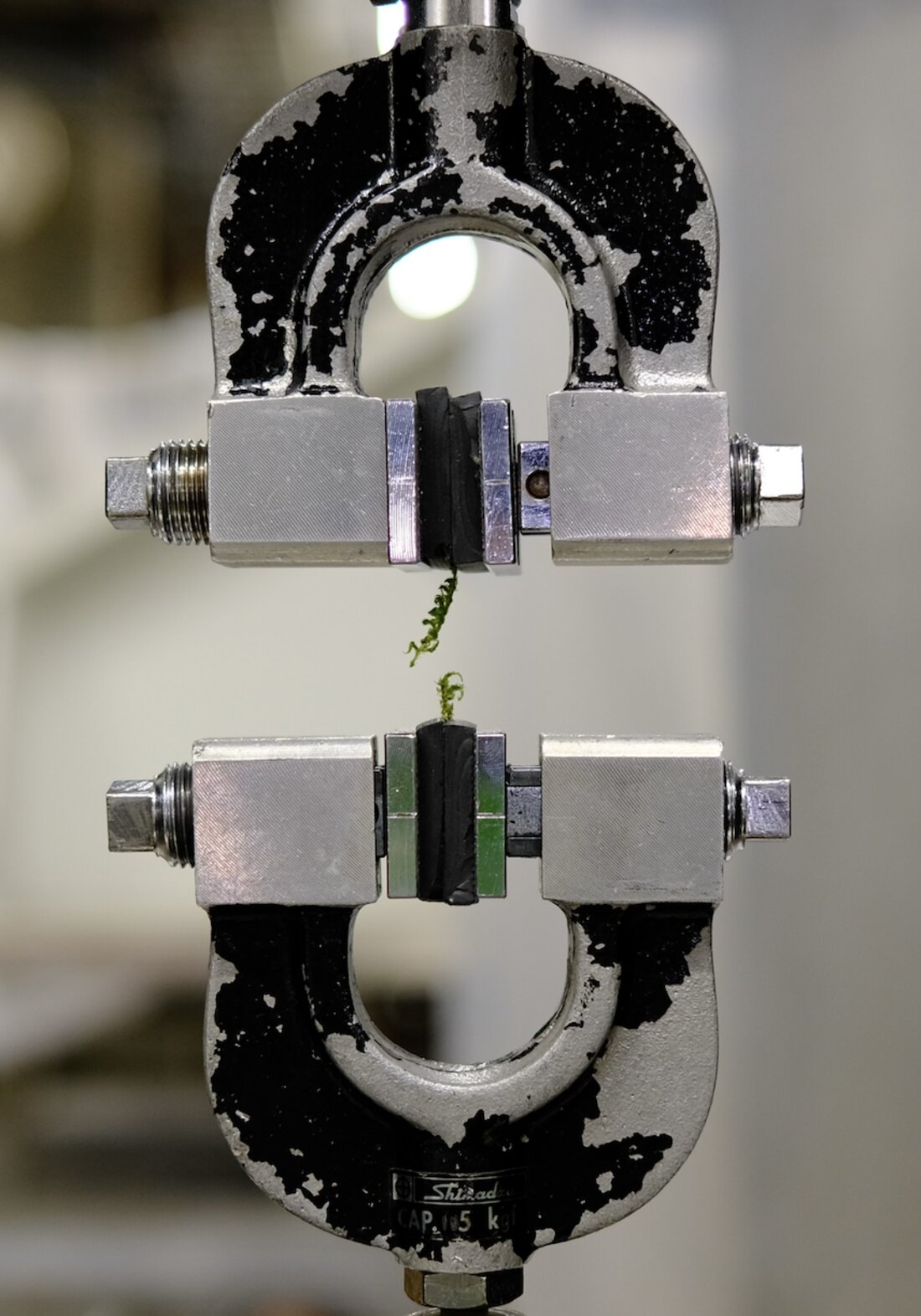
I did not want the claim “this works” to rest on impression. In a university materials lab, I ran tensile tests on a precision universal testing machine, benchmarked against cotton and polyester — and reported the results plainly, including the limits.
Twist as first-order structure, weave as second. Together they gave a living organism enough integrity to be worn.
The finished cloth held its structure through hours of movement — bending, twisting, walking — without unravelling. Not mass-producible fabric; a designed result, arrived at through iteration and measurement rather than luck.
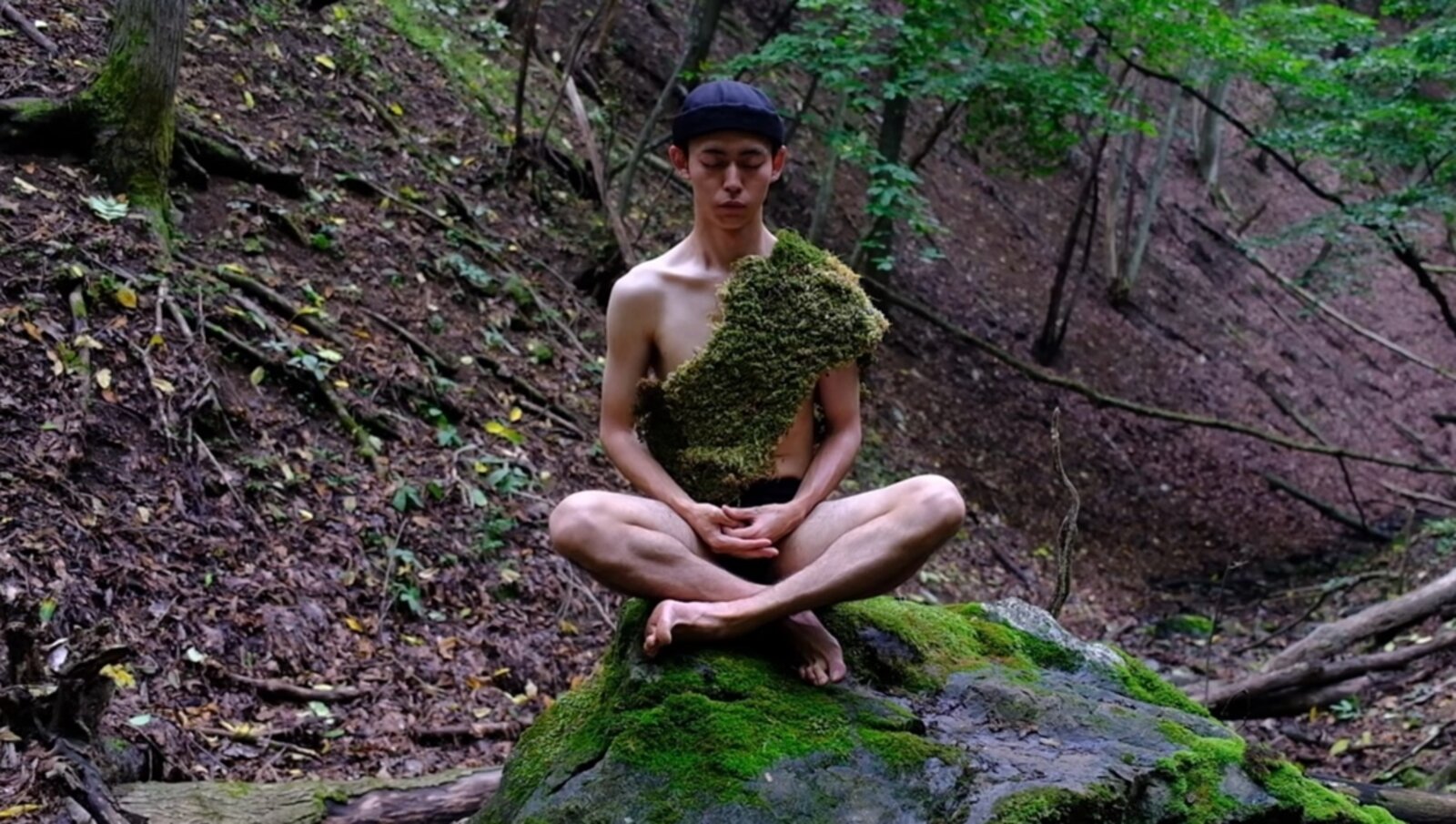
I wore the moss cloth into the mountains where the moss was gathered, and sat in zazen on a rock for about an hour.
Stillness was a design decision: only by holding still could the garment's real function — transmitting the environment into the skin rather than shielding it — accumulate slowly enough to be felt. What happened was not harmony. It was negotiation, and it cut both ways.
I warmed the moss: the moss chilled me. The closer we pushed toward union, the more clearly our incompatible physiologies asserted themselves. I named this thermal conflict — where each party's preferred condition is the other's stress, and neither can have both.熱的相克 · netsuteki sōkoku
Drawing on Tim Ingold's account of making as correspondence — the maker answering a material's own force rather than imposing a plan — the weaving was exactly this: I found the moss's rules and shaped my actions, even my fingertips, around them.
Applied across the species line, the pursuit of resonance produced not resonance but physiological refusal. I take that refusal as the finding, not the disappointment. If life is a meshwork generated through entanglement rather than through separate, self-contained individuals, then the discomfort — the cold, the die-off, the insects, the rejection — is the evidence that a real crossing with another being took place.
So the project proposes a third model of co-existence, beyond contemplation and beyond management: co-existence as mutual interference — where both parties step out of safety, accept that the other can alter and damage them, and keep searching for a temporary point of balance. For the Anthropocene, that negotiated, lossy, non-harmonious entanglement may be a more honest picture of living with other species than any image of seamless harmony.
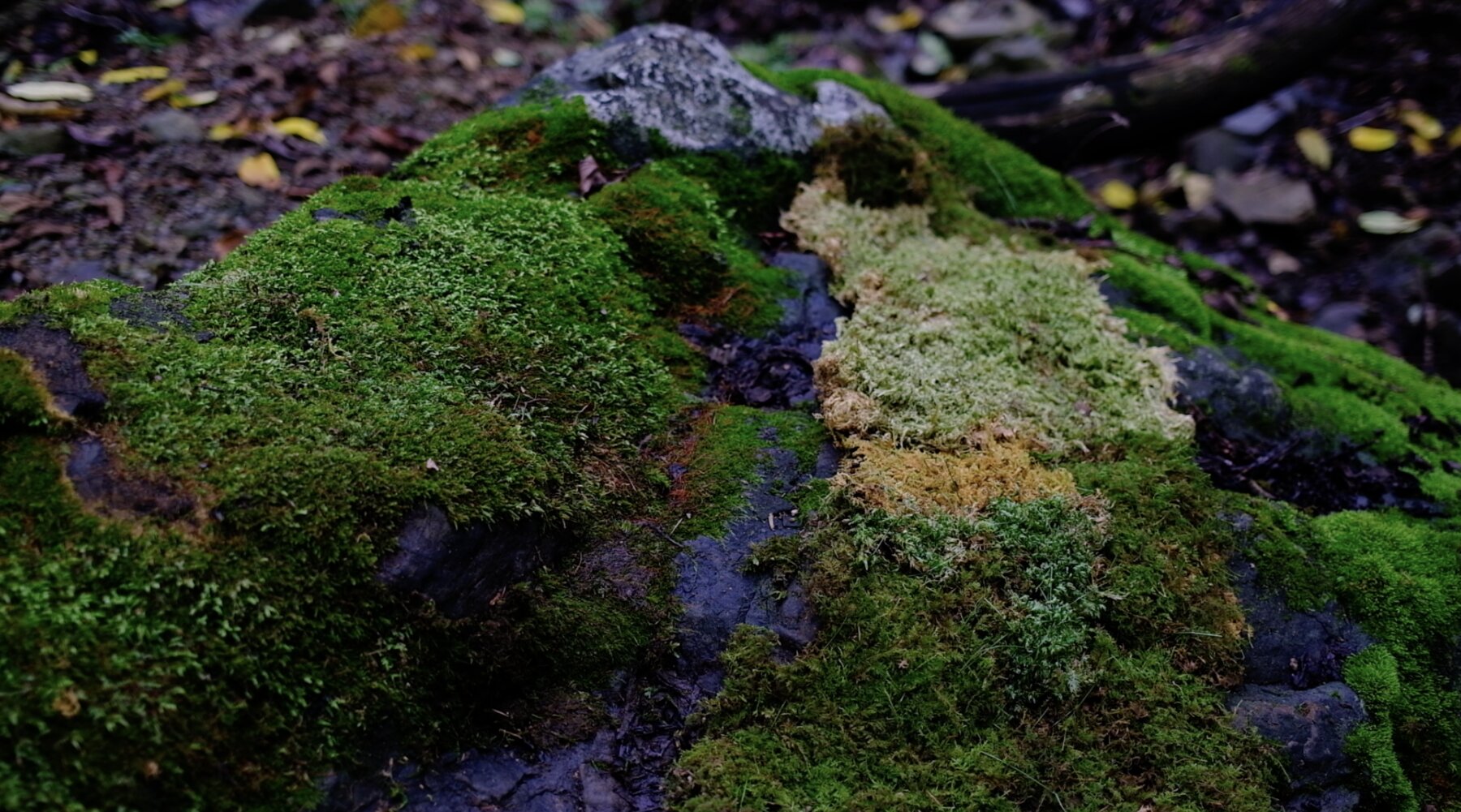
And the whole act had a shape: the moss was borrowed, not taken. Gathered living from a mountainside, spun and woven and worn — passed through the human cycle of production, use, and consumption — and then carried back and returned, still alive, to the same rock it came from. The garment was never a product to be kept. It was a loan from a living system, held for a while at the closest possible distance, and given back.